
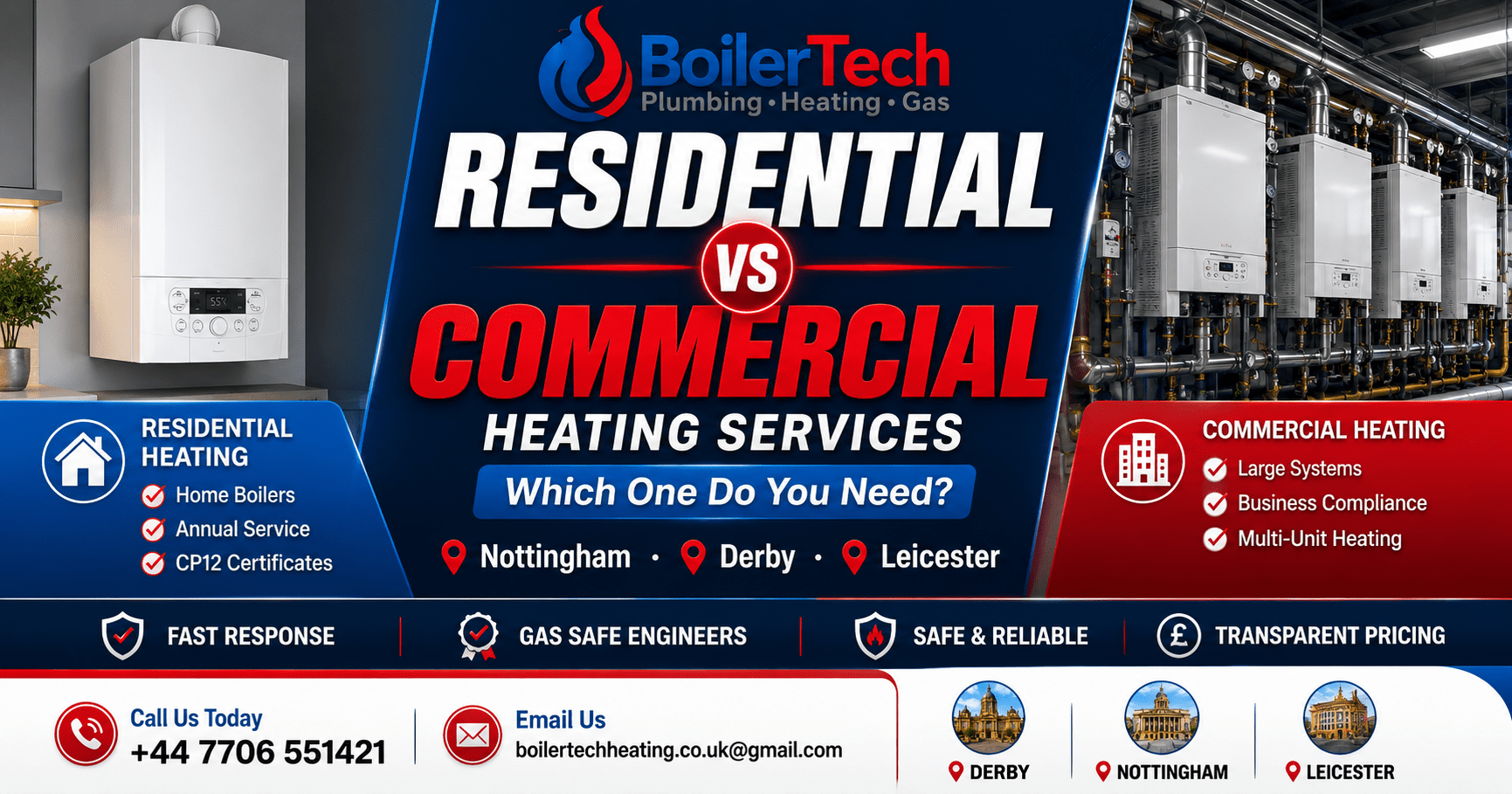
Boiler Tech Heating is Best for Residential & Commercial Heating Services in Nottingham, Derby & Leicester
Commercial heating services are not interchangeable with residential ones, even though they’re often lumped together in a single “boiler engineer” search. A landlord managing a block of flats, a restaurant owner who can’t afford a single day without hot water, and a homeowner booking an annual service all need very different things from the engineer they call. Getting this wrong — hiring a residential-only engineer for a commercial system, or overpaying for commercial-grade service on a simple domestic job — costs time, money, and sometimes compliance headaches that are entirely avoidable.
This guide explains the real differences between residential and commercial heating work, what each requires, and why Boiler Tech Heating is trusted by both homeowners and businesses across Nottingham, Derby, and Leicester.
Residential and Commercial Heating Services: What’s Actually Different?
At a basic level, both residential and commercial heating services involve installing, maintaining, and repairing boilers and heating systems. The differences show up in scale, compliance requirements, and how much tolerance there is for downtime.
Residential heating typically involves a single domestic boiler serving one household, straightforward annual servicing requirements, and — for landlords — an annual CP12 gas safety certificate per property.
Commercial heating often involves larger-capacity boilers or multiple units, more complex controls serving bigger or multi-zone spaces, stricter compliance obligations under building and fire safety regulations, and — critically — a much lower tolerance for unplanned downtime, since a broken heating system in a business can mean lost trade, unsafe working conditions, or regulatory non-compliance.
An engineer comfortable working on a single domestic combi boiler isn’t automatically equipped to service a commercial system supplying an entire office block or restaurant kitchen — the qualifications, equipment, and risk considerations are meaningfully different.
Why Businesses Need Specialist Commercial Heating Services
Choosing the right provider for residential and commercial heating services makes a measurable difference to safety, compliance, and cost. Commercial heating systems carry responsibilities that go well beyond a routine domestic service:
Higher-capacity systems. Commercial boilers are often significantly larger and more complex than domestic units, sometimes involving multiple boilers working together to serve a larger space, which requires specific commercial qualifications to install and maintain safely.
Stricter compliance obligations. Businesses are subject to workplace health and safety regulations that go beyond standard domestic gas safety rules, including specific requirements around ventilation, signage, and record-keeping for commercial gas appliances.
Lower tolerance for downtime. A restaurant without hot water or heating can lose an entire day’s trade. An office without heating in winter isn’t just uncomfortable — it can breach an employer’s duty of care obligations under UK workplace regulations. Commercial clients need engineers who understand the urgency and can prioritise accordingly.
Insurance and liability considerations. Commercial insurance policies typically require heating and gas work to be carried out by an engineer holding the correct commercial gas qualifications, not just standard domestic registration — using the wrong category of engineer can invalidate cover.
Types of Commercial Properties We Serve
Boiler Tech Heating provides residential and commercial heating services across a wide range of property types in Nottingham, Derby, and Leicester: Boiler Tech Heating provides commercial heating services across a wide range of property types in Nottingham, Derby, and Leicester:
- Offices — reliable heating for staff comfort and to meet workplace temperature obligations under UK health and safety guidance
- Restaurants and food service premises — commercial gas appliance servicing where safety compliance is especially strict, given the concentration of gas equipment typically found in commercial kitchens
- Retail units — heating systems that need to perform reliably through opening hours without disrupting trade
- Warehouses and industrial units — larger-scale heating systems suited to bigger, harder-to-heat spaces
- Rented residential portfolios — landlords and property managers overseeing multiple properties who need coordinated servicing and gas safety certification across their entire portfolio
Commercial Heating Services: Installation & Compliance
Installing or replacing a commercial boiler involves more regulatory groundwork than a typical residential swap. Considerations include:
Commercial Gas Safe registration. Engineers must hold the specific commercial gas qualifications relevant to the size and type of system being installed — this is a different, additional category to standard domestic Gas Safe registration, and it’s worth confirming directly with any engineer quoting for commercial work.
Building Regulations compliance. Commercial heating installations must meet Building Regulations Part L requirements around energy efficiency, which can involve more detailed documentation than a residential job.
Energy efficiency standards for commercial landlords. If you let commercial property, current Minimum Energy Efficiency Standard (MEES) guidance from gov.uk sets out requirements that can directly affect what heating upgrades are needed before a commercial property can legally be let.
Fire and ventilation safety. Commercial spaces, particularly food service premises, often have additional ventilation and fire safety considerations that must be factored into both the heating system design and its ongoing maintenance schedule.
Minimising Downtime for Business Clients
For commercial clients, avoiding downtime is often just as important as the quality of the installation itself. Boiler Tech Heating supports business continuity through:
- Priority response times for commercial clients experiencing a heating failure, recognising the direct trading impact a breakdown can have
- Planned maintenance contracts, scheduling routine servicing at times that minimise disruption to business operations rather than defaulting to standard working hours
- Out-of-hours emergency callouts, since many commercial heating faults are best addressed outside trading hours to avoid disrupting customers or staff
- Clear communication on timelines, so business owners can plan around a repair rather than being left guessing when heating will be restored
- This is exactly why choosing a provider experienced in both residential and commercial heating services matters more than simply picking the cheapest quote.
Residential Heating Services: A Quick Recap
While commercial work has its own specific requirements, residential heating remains at the core of what Boiler Tech Heating does every day — boiler installation, repair, annual servicing, central heating system work, and landlord gas safety certification for individual rental properties across Derby, Nottingham, and Leicester. Homeowners get the same Gas Safe registered standard of work as our commercial clients, scaled appropriately to a single-property domestic system.
Where We Provide Residential & Commercial Heating Services
Derby — Fast boiler installation, repair, and heating services across Derby city and the surrounding areas, covering both individual homes and local businesses.
Nottingham — Complete heating solutions for homes and businesses throughout Nottingham, from single-property landlords to multi-site commercial clients.
Leicester — The same Gas Safe registered standard of residential and commercial heating services now available to homes and businesses across Leicester.
East Midlands — Full coverage across the wider East Midlands region, including surrounding towns, with the same commitment to compliance and reliability regardless of property type or size.
Why Choose Boiler Tech Heating for Residential & Commercial Heating Services
Qualified for both domestic and commercial work. Our engineers hold the relevant Gas Safe registration categories for both residential and commercial gas appliances, so you’re never working with someone stepping outside their qualified scope.Every job — large or small — is treated with the same standard of residential and commercial heating services expertise.
One provider for mixed portfolios. Landlords and property managers overseeing a mix of residential lets and commercial units can consolidate all their heating and gas safety needs with a single trusted provider, rather than managing separate residential and commercial contractors.
Transparent, fixed pricing for both residential jobs and commercial contracts, agreed upfront with no vague estimates that grow once work begins.
Genuine local coverage across Derby, Nottingham, and Leicester, with engineers who understand the specific building stock and compliance expectations across the East Midlands.
Safety-first approach on every job, whether it’s a single domestic boiler service or a multi-unit commercial installation — compliance and safety are never treated as optional extras to be rushed through.
What to Ask Before Hiring a Heating Provider for Commercial Work
If you’re a business owner or property manager comparing quotes, these questions help separate a genuinely qualified commercial provider from one simply willing to take the job:
- Do you hold commercial Gas Safe registration, and can you provide the specific category relevant to our system?
- What’s your typical response time for a commercial heating breakdown, and is out-of-hours callout available?
- Can you provide a maintenance contract with scheduled servicing that fits around our trading hours?
- Do you have experience with our type of premises — for example, commercial kitchens, which carry additional gas safety considerations?
- Will we receive full compliance documentation after installation or servicing, including anything required for insurance or regulatory purposes?
- Can you support multiple sites under one contract, if our business operates across more than one location in the East Midlands?
A provider confident in their commercial capability will answer all six without hesitation — vague or evasive answers to any of these are worth treating as a warning sign before signing a contract, particularly around commercial Gas Safe registration and compliance documentation, since these are the two areas most likely to cause problems later if skipped.
Common Heating Challenges Specific to Commercial Properties
Commercial spaces often present heating challenges that simply don’t come up in a typical home, and understanding them helps explain why specialist experience matters.
Uneven heat distribution in large spaces. Warehouses, retail units, and open-plan offices can be difficult to heat evenly, particularly in spaces with high ceilings or large open floor areas. Getting this right often involves zoning controls and correctly sized equipment rather than simply installing a bigger boiler.
Extended operating hours. Many commercial premises run heating for far longer hours than a typical household — some restaurants and retail units effectively need heating available from early morning until late evening, seven days a week, which puts significantly more operational hours on the system annually than a domestic boiler ever experiences.
Multiple appliances on one system. Commercial kitchens in particular often run several gas appliances — ovens, fryers, water heaters — off a shared supply, which requires careful load calculation and ventilation planning that a domestic-only engineer may not be familiar with.
Regulatory inspections. Commercial premises are more likely to face inspection from environmental health, fire safety, or health and safety officers, all of whom may expect to see up-to-date compliance documentation for heating and gas appliances on request.
The Value of a Planned Maintenance Contract for Businesses
Reactive repairs — waiting for something to break before calling an engineer — tend to cost businesses more over time than a planned maintenance approach, for a few clear reasons:
Fewer unplanned closures. Scheduled inspections catch developing faults before they cause a full breakdown, reducing the chance of an unplanned closure during trading hours.
Predictable budgeting. A maintenance contract with a fixed annual or quarterly cost is easier to budget for than unpredictable emergency call-out fees that tend to arrive at the worst possible time.
Stronger compliance record. Regular, documented servicing builds a clear compliance history, which is valuable both for insurance purposes and for demonstrating due diligence if a regulatory inspection ever occurs.
Priority access when something does go wrong. Clients on a maintenance contract are typically prioritised for emergency callouts ahead of one-off enquiries, since the provider already has a working relationship and full system history on file.
Choosing Between a One-Off Repair and a Full System Upgrade
Business owners often face a judgement call when an ageing commercial heating system starts showing its age: repair the current system, or invest in a full upgrade. A few questions help guide that decision:
- How old is the current system, and how frequently has it needed repairs in the last two years? Frequent repairs on an older system often signal it’s approaching the point where replacement becomes more cost-effective than ongoing patching.
- Would an upgrade improve energy efficiency enough to offset the investment? Older commercial boilers can run significantly less efficiently than modern condensing systems, and for premises with high heating demand, the running-cost savings can be substantial over a few years.
- Are there compliance deadlines approaching, such as energy efficiency standards for rented commercial property, that would require an upgrade regardless of the current system’s condition?
- What’s the cost of downtime during the works, and can it be scheduled around quieter trading periods to minimise business disruption?
A specialist commercial heating provider should be able to talk through these trade-offs honestly, rather than defaulting to whichever option is more profitable for them to sell. In practice, this is one of the clearest signals of a trustworthy provider versus one purely focused on selling the most expensive job available — a specialist will sometimes recommend a well-timed repair over a premature replacement, even if it means a smaller invoice today.
What Homeowners Can Learn From Commercial-Grade Maintenance Standards
Interestingly, some of the discipline that commercial heating maintenance requires is worth borrowing for residential properties too. Homeowners who treat their boiler servicing with the same “planned, not reactive” mindset that businesses are required to adopt tend to see fewer breakdowns, lower long-term repair costs, and a boiler that reliably lasts closer to the top end of its expected working life. The core principle is the same regardless of scale: a heating system maintained on a fixed schedule, with proper documentation kept, consistently outperforms one that’s only looked at once something has already gone wrong.
Book Residential or Commercial Heating Services in Nottingham, Derby & Leicester
Whether you need a single boiler serviced at home or a heating contract managed across multiple commercial units, Boiler Tech Heating provides Gas Safe registered residential and commercial heating services across Nottingham, Derby, Leicester, and the wider East Midlands — trusted residential and commercial heating services from a single, accountable local provider.
Call: +44 7706 551421 Office: 192 Warwick Ave, Derby DE23 6HP Get a Free Residential or Commercial Quote →
Frequently Asked Questions
What’s the difference between residential and commercial heating services? Residential heating typically involves a single domestic boiler with standard servicing and gas safety requirements. Commercial heating usually involves larger or multiple units, stricter compliance obligations, and a much lower tolerance for downtime, requiring engineers with additional commercial Gas Safe qualifications.
Does Boiler Tech Heating work with restaurants and commercial kitchens? Yes. Commercial kitchens require particular attention to gas safety given the concentration of gas appliances typically involved, and our engineers hold the relevant commercial qualifications for this type of work.
Can I get a maintenance contract for multiple commercial properties? Yes. Landlords and property managers overseeing multiple sites can arrange scheduled servicing and gas safety certification across their full portfolio through a single point of contact.
How quickly can a commercial heating breakdown be fixed? Response times depend on the nature of the fault, but priority response is available for commercial clients given the direct trading impact a heating failure can cause. Out-of-hours callouts can also be arranged to minimise disruption.
Do commercial heating installations need to meet different regulations to residential ones? Yes. Commercial installations must meet Building Regulations Part L requirements and, for rented commercial property, current Minimum Energy Efficiency Standard (MEES) guidance, in addition to standard gas safety regulations.
