
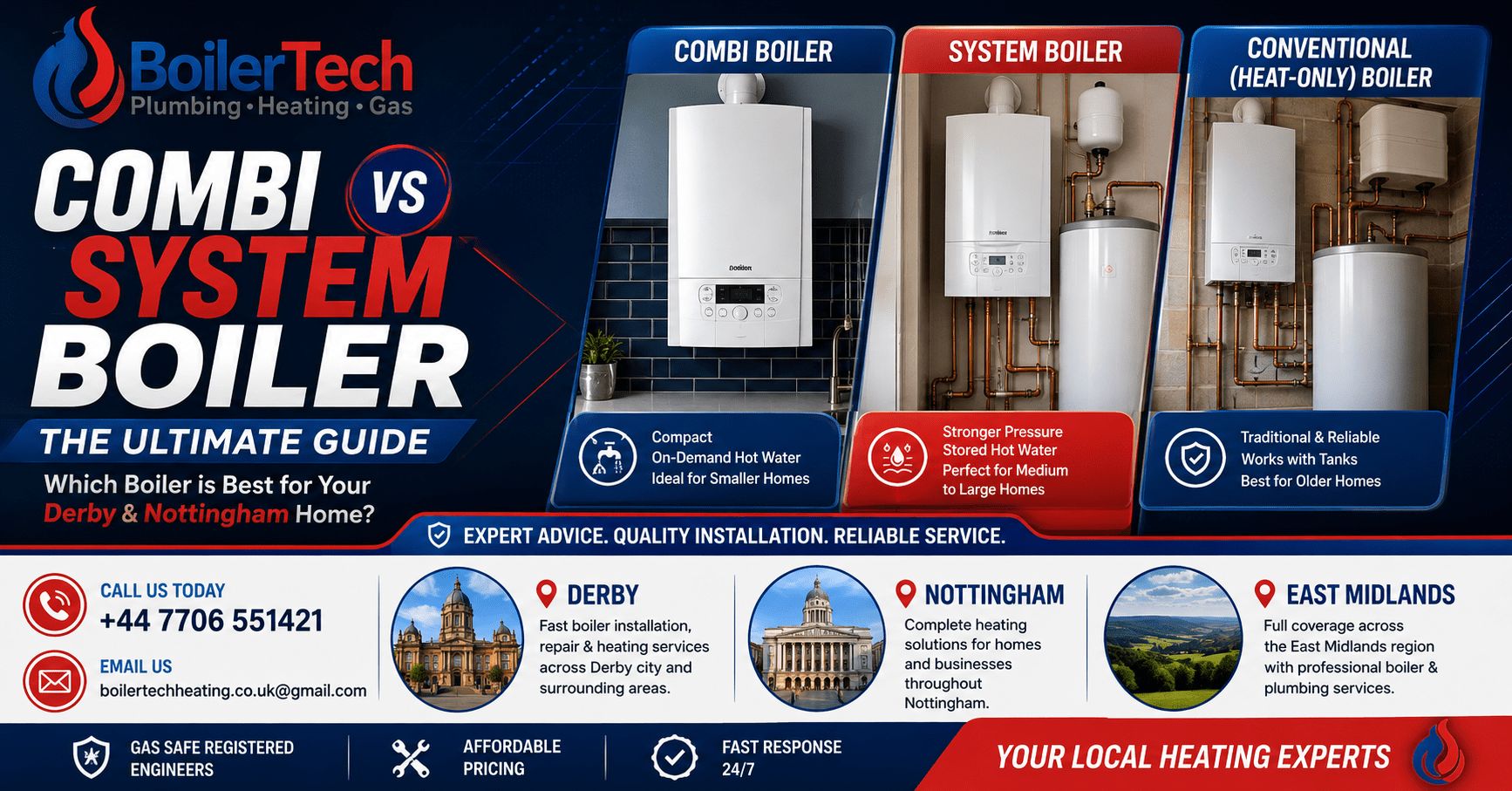
Combi vs System Boiler: Best Guide for Derby & Nottingham Homes
Combi vs system boiler is one of the most common questions homeowners in Derby and Nottingham ask us before a new installation — and it’s an important one to get right, because the wrong choice can mean poor hot water pressure, wasted space, or paying for capacity your household will never use. Add a third option, the conventional (heat-only) boiler, and it’s easy to see why so many people get stuck comparing spec sheets instead of just picking what suits their home.
This guide breaks down the real differences between a combi, a system, and a conventional boiler in plain terms — cost, hot water performance, space requirements, and which type actually suits different kinds of homes — so you can walk into your installation quote already knowing what you need.
Combi vs System Boiler: The Short Answer
If you only read one paragraph, here it is:
A combi boiler heats water directly from the mains on demand, with no tank or cylinder needed — best for smaller homes and flats with one bathroom and modest hot water demand. A system boiler stores hot water in a cylinder but takes its water supply from the mains, giving stronger, more consistent pressure to multiple bathrooms at once — best for medium to larger homes. A conventional (heat-only) boiler uses both a hot water cylinder and a cold water tank, usually found in older properties, and suits homes that already have that setup and don’t want to change the pipework.
The rest of this guide explains exactly why each type suits different households, so you can match the boiler to your home rather than the other way around.
What Is a Combi Boiler?
A combi (combination) boiler heats water directly from the mains supply whenever you turn on a hot tap, with no separate hot water cylinder or cold water tank required. Everything — central heating and hot water — is handled by one compact unit, usually wall-mounted in a kitchen cupboard or utility room.
Advantages of a combi boiler:
- Unlimited hot water on demand (as long as the tap is running, hot water keeps coming)
- No hot water cylinder or loft tank, freeing up airing cupboard and loft space
- Generally the cheapest and quickest type to install, since there’s less pipework involved
- Compact and well suited to flats, apartments, and smaller homes
Drawbacks of a combi boiler:
- Hot water pressure and flow can drop noticeably if two outlets are used at once (e.g. a shower running while the kitchen tap is on)
- Not ideal for homes with more than one bathroom or high simultaneous hot water demand
- If the boiler breaks down, you lose both heating and hot water at the same time
What Is a System Boiler?
A system boiler heats water and stores it in a hot water cylinder, but — unlike a conventional boiler — it takes its water supply directly from the mains rather than from a cold water tank in the loft. Most of the major components (pump, expansion vessel) are built into the boiler itself, which keeps installation relatively straightforward.
Advantages of a system boiler:
- Strong, consistent water pressure to multiple bathrooms or outlets running at the same time
- No cold water tank needed in the loft, unlike a conventional boiler
- Reliable performance for medium to larger households with higher hot water demand
- Hot water is stored and ready, so there’s no “wait for it to heat up” delay like some setups can have
Drawbacks of a system boiler:
- Requires space for a hot water cylinder, usually in an airing cupboard
- Hot water supply is limited to what’s stored in the cylinder — a full house of guests taking back-to-back showers can eventually run it down
- Slightly higher installation cost than a combi due to the additional cylinder and pipework
What Is a Conventional (Heat-Only) Boiler?
A conventional boiler, sometimes called a regular or heat-only boiler, is the traditional setup found in many older UK homes. It uses both a cold water tank (usually in the loft) and a separate hot water cylinder (usually in an airing cupboard), with the boiler itself just heating the water that flows between them.
Advantages of a conventional boiler:
- Works well in homes that already have this system in place — no need to rip out tanks and pipework
- Can supply multiple bathrooms simultaneously, since the tank and cylinder store a large volume of water
- Still functions during a mains water outage, since the loft tank holds a reserve supply
- Often the best fit for homes with older, low-pressure pipework that isn’t compatible with a combi or system boiler
Drawbacks of a conventional boiler:
- Takes up the most space of the three options — a loft tank and an airing cupboard cylinder
- Hot water is limited to the cylinder’s capacity, and running out means waiting for it to reheat
- Generally the most expensive and time-consuming to install from scratch, due to the extra tanks and pipework
Combi vs System Boiler: Cost Comparison
| Boiler Type | Typical Unit Cost | Typical Installation Cost | Total (Unit + Install) |
|---|---|---|---|
| Combi boiler | £700 – £1,700 | £700 – £1,200 | £1,400 – £2,900 |
| System boiler | £800 – £1,900 | £900 – £1,500 | £1,700 – £3,400 |
| Conventional boiler | £700 – £1,800 | £1,000 – £1,800 | £1,700 – £3,600 |
These figures reflect typical Derby and Nottingham pricing for a straightforward like-for-like replacement. Costs rise if you’re converting from one boiler type to another (for example, switching from a conventional system to a combi), since that involves removing tanks, rerouting pipework, and sometimes patching up the loft or airing cupboard space left behind.
Combi vs System Boiler: Which Suits Your Household?
The honest answer depends less on which boiler is “better” and more on which one matches how your household actually uses hot water. Here’s how to think it through:
Choose a combi boiler if:
- You live in a flat, apartment, or smaller home with one bathroom
- You don’t need hot water running in two places at exactly the same time
- You want to free up space currently used by a tank or cylinder
- You want the simplest, generally most affordable installation
Choose a system boiler if:
- You have two or more bathrooms, or regularly need hot water in multiple places at once
- You have decent mains water pressure to take advantage of
- You want stored hot water ready to go without waiting for it to heat on demand
- You have space for a cylinder but want to avoid a loft tank
Choose a conventional boiler if:
- Your home already has a working tank-and-cylinder system and the pipework isn’t suited to a change
- You have low mains water pressure that wouldn’t perform well with a combi or system boiler
- You have a large household with very high simultaneous hot water demand across several bathrooms
- You want a backup water supply in case of a mains outage
Common Mistakes When Choosing Between Combi and System Boilers
Choosing based on price alone. The cheapest boiler to install isn’t always the cheapest to run, or the right fit for your household’s hot water habits. A combi that constantly struggles with low pressure across two bathrooms will frustrate you daily, even if it saved money upfront.
Not checking mains water pressure first. Combi and system boilers both rely on decent mains pressure to perform well. In some older streets in Derby and Nottingham, mains pressure can be lower than expected — this should always be tested before committing to a boiler type, not discovered after installation.
Assuming bigger is always better. An oversized system boiler with a large cylinder in a one-bathroom flat wastes space and money on capacity that will never be used. Sizing should match actual household hot water demand, not a general assumption that more is safer.
Ignoring future plans. If you’re planning a loft conversion, an extra bathroom, or an extension in the next few years, it’s worth factoring that into your boiler choice now, rather than needing a costly conversion shortly after installing a new one.
Energy Efficiency: Is One Type More Efficient Than the Others?
All modern condensing boilers — combi, system, or conventional — are required to meet the same minimum efficiency standards in the UK, typically rated around 92–94% efficiency when properly installed and maintained. The bigger efficiency factor isn’t which type you choose, but:
- Correct sizing for your home (an oversized boiler cycles inefficiently)
- Proper annual servicing to keep the heat exchanger and burner performing correctly
- Good insulation and heating controls working alongside the boiler
According to the Energy Saving Trust, choosing the correctly sized boiler for your home’s actual heat and hot water demand has a bigger impact on your energy bills than the specific type of boiler you choose.
Switching Boiler Types: What to Expect
If you currently have a conventional boiler and are considering switching to a combi or system boiler, it’s worth knowing this is a bigger job than a straightforward like-for-like swap. It typically involves:
- Removing the loft cold water tank (for a combi) or relocating pipework (for a system)
- Capping off and rerouting existing pipework to the new configuration
- Patching and making good the loft and airing cupboard space left behind
- Checking and potentially upgrading mains water pressure and pipe diameter to support the new boiler type
This work usually adds one to two extra days of labour compared to a like-for-like replacement, and should always be quoted separately so there are no surprises on installation day.
Combi vs System Boiler: A Quick Decision Checklist
Ask yourself these four questions:
- How many bathrooms need hot water, and how often at the same time? One bathroom → combi is usually fine. Two or more used simultaneously → lean system or conventional.
- How’s your mains water pressure? Strong and consistent → combi or system both work well. Weak or inconsistent → conventional may be more reliable, or a pressure upgrade may be needed first.
- How much space do you have? Very limited → combi. Some airing cupboard space but no loft tank wanted → system. Existing tank and cylinder already in place → conventional often makes the most sense.
- What’s your budget for installation, not just the unit? Combi is typically the most affordable to install from scratch; converting between types adds cost regardless of which direction you’re switching.
Combi vs System Boiler: Lifespan and Maintenance Differences
The number of moving parts and system complexity affects not just installation cost but long-term maintenance too.
Combi boilers have fewer components overall — no separate cylinder, no tank, no additional pipework — which generally makes annual servicing quicker and slightly cheaper. However, because a combi handles both heating and hot water through a single unit working harder on demand, some engineers note they can show wear on internal components a little sooner under very heavy daily use, particularly in busy households.
System boilers have an additional component — the hot water cylinder — which needs periodic checks of its own, such as the immersion heater (if fitted as a backup) and the cylinder’s insulation jacket. The boiler itself tends to cycle less aggressively than a combi handling instant demand, which can support a comparably long working life.
Conventional boilers have the most components to maintain — tank, cylinder, and associated valves and pipework — meaning more potential points of wear, but also more redundancy if one part needs attention while the rest of the system keeps functioning.
In all three cases, typical working life sits around 10–15 years with proper annual servicing, and skipping servicing is a far bigger factor in reduced lifespan than the boiler type itself.
Combi vs System Boiler: Impact on Home Value and Buyer Expectations
If you’re renovating with resale in mind, it’s worth knowing how boiler type can factor into how a property is perceived by future buyers or tenants.
For flats and smaller homes, a combi boiler is generally what buyers expect and is rarely seen as a downside — the lack of a tank or cylinder is often viewed as a space-saving positive.
For larger family homes, particularly those with two or more bathrooms, some buyers specifically look for a system or conventional boiler because they’ve previously experienced poor water pressure with a combi in a similarly sized property. Estate agents in Derby and Nottingham increasingly note hot water performance as a talking point during viewings of larger homes.
For rental properties, landlords often favour combi boilers for their lower footprint and simpler servicing requirements across multiple properties, provided the property doesn’t have more than one bathroom in regular simultaneous use.
None of this means one boiler type is objectively worth more — it means matching the boiler to the property type avoids future complaints or renegotiations, whether you’re selling, renting, or simply planning to stay long-term.
Frequently Overlooked Factors in the Combi vs System Boiler Decision
A few details get missed in most online comparisons, but matter in practice:
Noise levels. Combi boilers cycle on and off more frequently to respond to instant hot water demand, which some homeowners notice more than the steadier operation of a system boiler drawing from a cylinder. This is rarely a dealbreaker, but worth considering if the boiler will be installed near a bedroom or living space.
Boiler location flexibility. A combi boiler’s compact size gives more flexibility over where it can be installed — kitchen cupboards, utility rooms, even some bathrooms with the right ventilation. A system or conventional boiler’s cylinder needs a dedicated space, usually an airing cupboard, which isn’t always available in smaller properties without some remodelling.
Simultaneous heating and hot water demand. A well-known limitation of some combi boilers is reduced central heating performance while hot water is being drawn — for example, radiators cooling slightly while a shower is running. Modern combi boilers have largely improved this with better internal prioritisation, but it’s worth asking your installer how a specific model handles simultaneous demand before committing.
Government incentives. Depending on your current heating setup and eligibility, schemes such as the Boiler Upgrade Scheme may apply differently depending on whether you’re doing a straightforward gas boiler replacement or considering a switch toward heat pump-compatible systems in future — worth checking current eligibility via <a href=”https://www.gov.uk/apply-boiler-upgrade-scheme” target=”_blank” rel=”noopener”>gov.uk</a> before finalising your installation plans.
Combi vs System Boiler Installation in Derby & Nottingham
At Boiler Tech, our Gas Safe registered engineers assess your household’s hot water demand, mains pressure, and available space before recommending a boiler type — not the other way around. We install and service combi, system, and conventional boilers across Derby, Nottingham, and the wider East Midlands, with fixed-price quotes and no pressure to upsize beyond what your home actually needs.
Get a Free Boiler Installation Quote →
Frequently Asked Questions
Is a combi or system boiler better for a 3-bedroom house? It depends on the number of bathrooms and hot water demand, not bedroom count alone. A 3-bedroom house with one bathroom often works fine with a combi; a 3-bedroom house with two bathrooms used at similar times of day is usually better served by a system boiler.
Can I switch from a conventional boiler to a combi boiler? Yes, but it’s a bigger job than a like-for-like replacement, involving removing the tank and cylinder and rerouting pipework. It typically adds one to two extra days of labour and should be quoted separately.
Do system boilers need a loft tank? No — that’s the key difference from a conventional boiler. A system boiler takes water directly from the mains and only needs a hot water cylinder, not a cold water tank in the loft.
Which is cheaper to run, a combi or system boiler? Running costs are driven mainly by correct sizing, insulation, and annual servicing rather than boiler type itself. Both combi and system boilers, when properly sized and maintained, achieve similar efficiency ratings.
How do I know my home’s mains water pressure before choosing a boiler? A Gas Safe registered engineer can test your mains pressure and flow rate during a home visit, which should always happen before confirming a boiler type — not after installation.
