
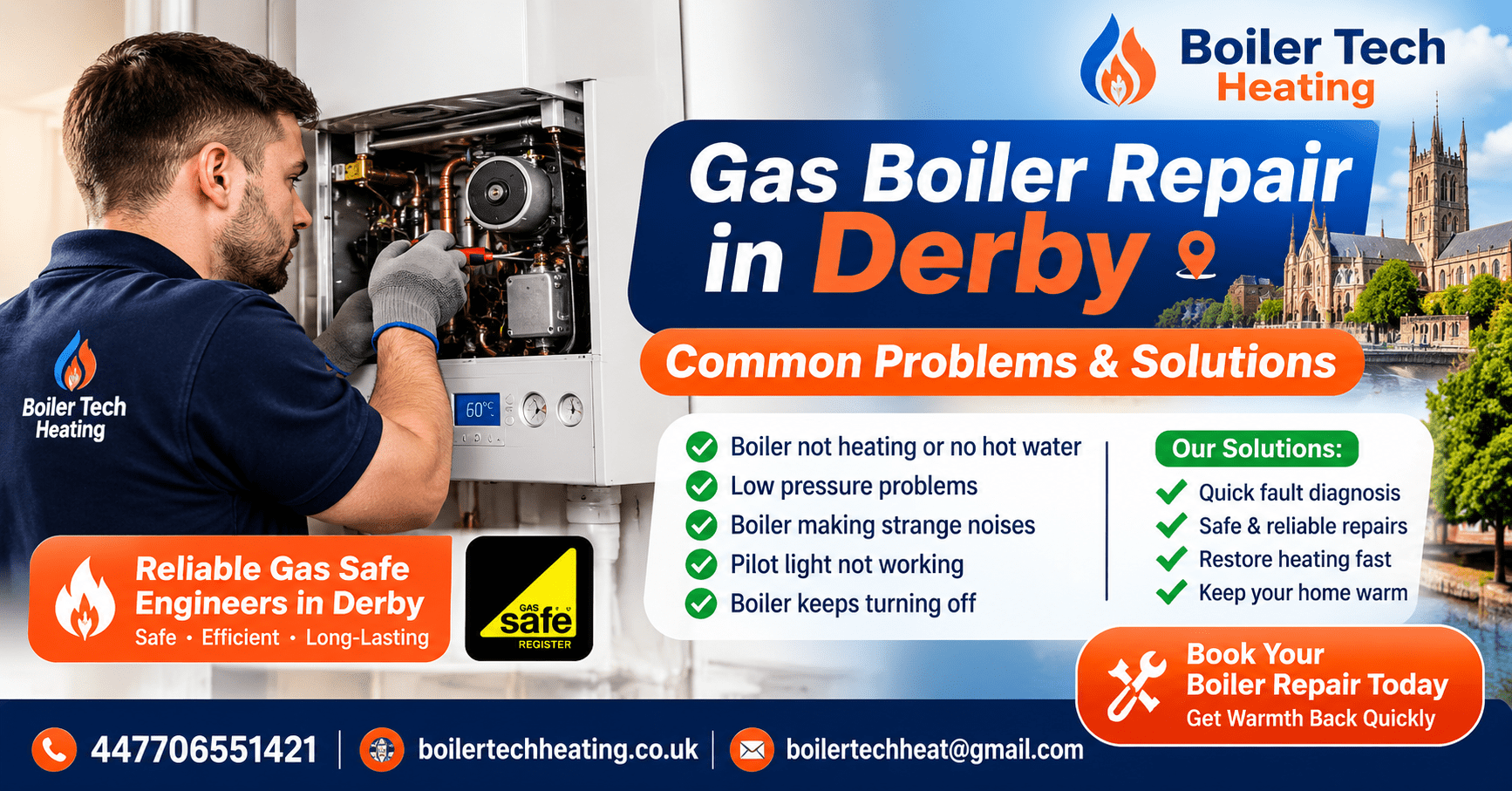
Gas Boiler Repair in Derby – Common Problems & Solutions
A reliable boiler is essential for keeping your Derby home warm and comfortable, especially during the colder months. When a gas boiler starts making unusual noises, losing pressure, producing error codes, or failing to heat water properly, getting the problem checked quickly can prevent a minor fault from becoming an expensive repair.
This comprehensive guide to gas boiler repair in Derby explains the most common boiler problems, their possible causes, practical solutions, warning signs, and when you should call a qualified heating professional.
Why Regular Boiler Maintenance Matters in Derby
Boilers work hard throughout the year, and their performance can gradually decline without proper servicing. A small issue such as low water pressure may seem harmless, but ignoring it can sometimes lead to more serious faults.
Regular boiler maintenance can help:
- Improve heating efficiency
- Reduce unexpected breakdowns
- Identify worn or faulty components
- Maintain consistent hot water
- Potentially lower energy consumption
- Extend the working life of the boiler
- Improve household safety
If your boiler is showing signs of trouble, arranging a professional inspection is usually safer than attempting to diagnose or repair gas-related components yourself.
Common Gas Boiler Problems in Derby
1. Boiler Has No Heating or Hot Water
One of the most frustrating boiler problems is discovering that your radiators are cold and your taps are not producing hot water.
There can be several possible causes, including:
- Low boiler pressure
- Thermostat problems
- Electrical issues
- Frozen condensate pipe
- Faulty pump
- Ignition failure
- Internal component faults
- Gas supply problems
Solution
First, check whether the boiler has power and whether the thermostat is set correctly. You can also check the pressure gauge if your boiler has one.
If the boiler displays an error code, consult the manufacturer’s instructions rather than repeatedly resetting it.
If basic checks do not solve the problem, contact a Gas Safe registered engineer in Derby for professional diagnosis and repair.
2. Low Boiler Pressure
Low pressure is one of the most common boiler issues. Many modern sealed heating systems operate within a specific pressure range, often around 1–1.5 bar when cold, although the correct level depends on the boiler and heating system.
Signs of low pressure may include:
- Boiler switching off
- Cold radiators
- Intermittent heating
- Pressure gauge reading below the recommended level
- Boiler displaying a pressure-related fault code
Possible Causes
Low pressure can result from:
- A water leak
- Recent radiator bleeding
- A problem with the expansion vessel
- A faulty pressure relief valve
- Loss of system water
Solution
If the pressure is only slightly low, the manufacturer’s instructions may explain how to safely depressurise the system.
However, if the pressure repeatedly drops, simply topping it up is not a permanent solution. A heating engineer should investigate the underlying cause.
3. Boiler Pressure Is Too High
High boiler pressure can also cause problems. If the pressure rises significantly when the heating is operating, there may be an issue with the expansion vessel or another component.
Potential signs include:
- Pressure gauge moving into the red zone
- Water leaking from the pressure relief pipe
- Boiler shutting down
- Pressure changing dramatically between heating cycles
Solution
Do not repeatedly release pressure without finding out why it is increasing.
A qualified engineer can inspect the expansion vessel, pressure relief valve and heating system to determine the cause and carry out the appropriate repair.
4. Boiler Making Strange Noises
Does your boiler sound like a kettle, humming machine or vibrating appliance? Strange noises should not automatically be ignored.
Common sounds include:
Kittling
A rumbling or whistling noise can sometimes indicate kittling, where mineral deposits or sludge restrict water flow through the heat exchanger.
Banging
Banging may indicate restricted circulation, trapped air or deposits inside the system.
Gurgling
Gurgling can sometimes be caused by air in the heating system or an issue with the condensate pipe.
Humming or Vibrating
A humming sound may be related to the pump, fan or other mechanical components.
Solution
The correct repair depends on the source of the noise. Professional cleaning, component replacement or system maintenance may be required.
If a boiler suddenly becomes much louder than normal, arrange an inspection rather than assuming the sound is harmless.
5. Boiler Keeps Switching Off
A boiler that repeatedly turns itself off can be particularly inconvenient.
Possible causes include:
- Low water pressure
- Overheating
- Blocked condensate pipe
- Faulty thermostat
- Poor circulation
- Ignition problems
- Component failure
- Gas supply issues
Modern boilers often shut themselves down when their safety systems detect abnormal conditions.
Solution
Check the boiler display for an error code and consult the manufacturer’s guidance.
If resetting the boiler does not resolve the issue, or the boiler repeatedly locks out, contact a qualified heating engineer. Repeatedly resetting a faulty boiler is not a substitute for proper diagnosis.
6. Frozen Condensate Pipe
During particularly cold Derby winters, an external condensate pipe can freeze.
A frozen condensate pipe may cause the boiler to stop working and display a fault code.
Common Signs
- Boiler suddenly stops operating
- Error code appears
- Gurgling sounds
- Condensate pipe feels extremely cold
- Heating and hot water stop
Solution
The manufacturer’s instructions may provide guidance for safely thawing a frozen condensate pipe.
If you are unsure how to deal with the problem, contact a qualified professional. Never use boiling water on a condensate pipe because sudden temperature changes can potentially damage plastic components.
Preventative insulation can also help reduce the risk of freezing.
7. Boiler Leaking Water
A leaking boiler should always be taken seriously.
Water may come from:
- A pressure relief valve
- Pipe connections
- Pump seals
- Internal components
- Corrosion
- Heating system pipework
Solution
If water is leaking from or around the boiler, turn off the appliance if it is safe to do so and arrange a professional inspection.
Do not remove the boiler casing yourself. Gas boiler components should be inspected and repaired by a suitably qualified professional.
8. Pilot Light or Ignition Problems
Older boilers may have a traditional pilot light, while many modern boilers use electronic ignition.
If the boiler repeatedly fails to ignite, possible causes include:
- Ignition electrode problems
- Flame sensor faults
- Gas supply issues
- Electrical faults
- Blocked components
- Control board problems
Solution
Check whether other gas appliances are working, provided it is safe to do so. If there appears to be a wider gas supply problem, contact the appropriate emergency or gas service.
For boiler-specific ignition faults, a Gas Safe registered engineer should diagnose the appliance.
9. Radiators Are Cold or Only Partially Heating
Sometimes the boiler is working but the radiators are not heating evenly.
Common causes include:
- Air trapped in radiators
- Sludge build-up
- Incorrect system balancing
- Thermostatic radiator valve problems
- Circulation issues
- Boiler or pump faults
Solution
A radiator that is cold at the top may contain trapped air and may require bleeding. If several radiators remain cold or heating is uneven throughout the property, professional investigation may be necessary.
A heating engineer may recommend system balancing, cleaning or other repairs depending on the cause.
10. Thermostat Problems
Your boiler may be working correctly while the thermostat is causing heating problems.
Possible symptoms include:
- Heating will not turn on
- Heating remains on continuously
- Incorrect room temperature
- Thermostat display is blank
- Wireless thermostat loses connection
Solution
Check batteries if your thermostat uses them. Make sure the desired temperature is higher than the current room temperature and check the heating schedule.
If the thermostat still does not communicate correctly with the boiler, it may need repair or replacement.
11. Boiler Error Codes
Modern gas boilers often use digital displays to identify faults. An error code can provide useful information about what the boiler has detected.
However, error codes differ between manufacturers and models.
What Should You Do?
Write down the exact error code and check your boiler’s official manual.
Some minor issues may have simple reset procedures. Others require professional diagnosis.
Never assume that repeatedly resetting an error code will fix the underlying problem.
12. Hot Water Is Too Cold or Fluctuates
If your shower suddenly goes from hot to cold, the boiler may not be providing consistent hot water.
Possible causes include:
- Faulty diverter valve
- Blocked heat exchanger
- Flow sensor problems
- Thermostat issues
- Low water flow
- Boiler capacity limitations
Solution
A professional engineer can test the system and identify the faulty component.
In some cases, cleaning or servicing may resolve the issue. In others, a component may need replacing.
Emergency Gas Boiler Problems: When to Act Immediately
Some boiler problems are more urgent than others.
If you smell gas in your home, do not attempt to repair the boiler yourself.
As a general safety measure:
- Avoid flames and smoking.
- Do not operate electrical switches unnecessarily.
- If safe, turn off the gas supply.
- Leave the property if necessary.
- Contact the relevant gas emergency service or a qualified professional.
If you suspect carbon monoxide is present, leave the property and seek urgent assistance.
A carbon monoxide alarm is an important additional safety measure in homes with gas appliances.
Why Choose a Qualified Gas Boiler Repair Service in Derby?
Gas appliances require specialist knowledge and appropriate qualifications. Using an appropriately qualified professional helps ensure that repairs are carried out safely and correctly.
When searching for gas boiler repair in Derby, consider:
- Gas Safe registration
- Experience with your boiler manufacturer
- Transparent pricing
- Availability for urgent repairs
- Customer reviews
- Clear explanation of the fault
- Warranty or guarantee information where applicable
A reputable engineer should explain what has gone wrong and discuss the available repair options before unnecessary work is undertaken.
Boiler Repair or Boiler Replacement?
Not every faulty boiler needs replacing.
A repair may be sensible when:
- The boiler is relatively modern
- The fault is straightforward
- Replacement parts are available
- The appliance has been properly maintained
- Repair costs are reasonable
Replacement may be worth considering when:
- The boiler is very old
- Breakdowns are becoming frequent
- Parts are difficult to obtain
- Repairs are becoming expensive
- Efficiency is poor
- The boiler no longer meets your household’s needs
A qualified heating professional can assess the condition of your boiler and explain whether repair or replacement makes more financial sense.
How to Prevent Boiler Breakdowns
Although no boiler lasts forever, regular maintenance can reduce the likelihood of unexpected problems.
Book an Annual Boiler Service
An annual service allows a qualified engineer to inspect the appliance and identify potential problems.
Keep an Eye on Boiler Pressure
Check the pressure periodically and follow the manufacturer’s guidance if it falls outside the recommended range.
Do Not Ignore Strange Noises
A new banging, kittling or vibrating sound could indicate an underlying problem.
Protect External Pipework
Properly insulating exposed condensate pipework can help reduce the risk of freezing during cold weather.
Check Your Thermostat
A faulty or incorrectly programmed thermostat can make your heating appear unreliable even when the boiler itself is functioning properly.
Install a Carbon Monoxide Alarm
A suitable carbon monoxide alarm provides an additional layer of protection in properties with gas appliances.
How Much Does Gas Boiler Repair in Derby Cost?
The cost of boiler repair varies considerably depending on the fault, boiler model, parts required and labour involved.
A straightforward issue may cost less than a repair involving a major component.
Before agreeing to work, ask the engineer:
- What is the problem?
- What repair is required?
- How much will it cost?
- Are parts included?
- Is there a call-out charge?
- Is the repair guaranteed?
Avoid choosing a contractor solely because they offer the lowest initial price. Safety, qualifications and quality of workmanship are equally important.
Choosing the Right Boiler Repair Engineer in Derby
A quick online search for boiler repair Derby can produce numerous results, but choosing the right professional requires a little research.
Look for an engineer or company that:
- Is appropriately Gas Safe registered for gas work
- Has experience with domestic boilers
- Provides clear quotations
- Has genuine customer feedback
- Explains repairs clearly
- Does not pressure you into unnecessary replacement
- Provides relevant paperwork after servicing or repair
For rented properties, landlords should also ensure that legal gas safety requirements are met.
Conclusion
A faulty boiler can quickly turn a comfortable Derby home into a cold and inconvenient one. Problems such as low pressure, strange noises, ignition failures, frozen condensate pipes, leaking water and inconsistent hot water are relatively common, but the correct solution depends on the underlying cause.
Some basic checks can be performed safely by homeowners, but gas boiler repair should be handled by an appropriately qualified professional. Getting problems diagnosed early can help prevent further damage, improve heating performance and potentially save money in the long term.
Whether your boiler needs a minor repair, routine servicing or a professional assessment to determine whether replacement is more practical, choosing a reputable gas boiler repair service in Derby is an important step towards keeping your home warm and your heating system operating safely.
For ongoing reliability, arrange regular servicing, pay attention to unusual boiler behaviour, monitor system pressure and never ignore signs of a potential gas or carbon monoxide problem.
Frequently Asked Questions About Gas Boiler Repair in Derby
1. How do I know if my boiler needs repairing?
Common warning signs include no heating or hot water, repeated shutdowns, unusual noises, leaking water, low pressure, error codes and inconsistent hot water. If the problem keeps returning, professional diagnosis is recommended.
2. How often should a gas boiler be serviced?
An annual boiler service is commonly recommended. Landlords in the UK have specific legal duties regarding gas safety and should follow the applicable requirements.
3. Can I repair my gas boiler myself?
You should not attempt gas-related boiler repairs yourself. Gas work should be carried out by an appropriately qualified and registered professional.
4. Why does my boiler keep losing pressure?
Repeated pressure loss can be caused by leaks, a faulty pressure relief valve, expansion vessel problems or other system faults. Constantly topping up the pressure without investigating the cause is not a long-term solution.
5. Why is my boiler making a banging noise?
Banging may be caused by restricted water flow, trapped air, deposits or component problems. An engineer can identify the precise cause.
6. Why does my boiler stop working in cold weather?
Cold weather can expose problems such as a frozen condensate pipe. Extremely low temperatures can also place additional demand on heating systems.
7. Is a boiler leak dangerous?
A boiler leak can indicate a component or system fault and should be investigated promptly. Keep water away from electrical equipment and seek professional assistance.
8. Should I repair or replace my old boiler?
It depends on its age, condition, efficiency, repair history and replacement cost. A qualified heating engineer can help you compare the options.
9. How quickly can a boiler repair be completed in Derby?
Repair times vary depending on the fault and whether replacement parts are available. Simple faults may be resolved during the initial visit, while more complex repairs can take longer.
10. How can I find a reliable boiler repair service in Derby?
Check that the engineer is appropriately Gas Safe registered, compare reviews, ask for clear pricing and choose a professional with experience repairing your type of boiler
Primary Keyword
- Gas Boiler Repair in Derby
Secondary Keywords
- boiler repair Derby
- gas boiler repair Derby
- boiler repair services Derby
- boiler engineer Derby
- gas engineer Derby
- boiler servicing Derby
- emergency boiler repair Derby
- boiler breakdown Derby
- boiler maintenance Derby
- central heating repair Derby
